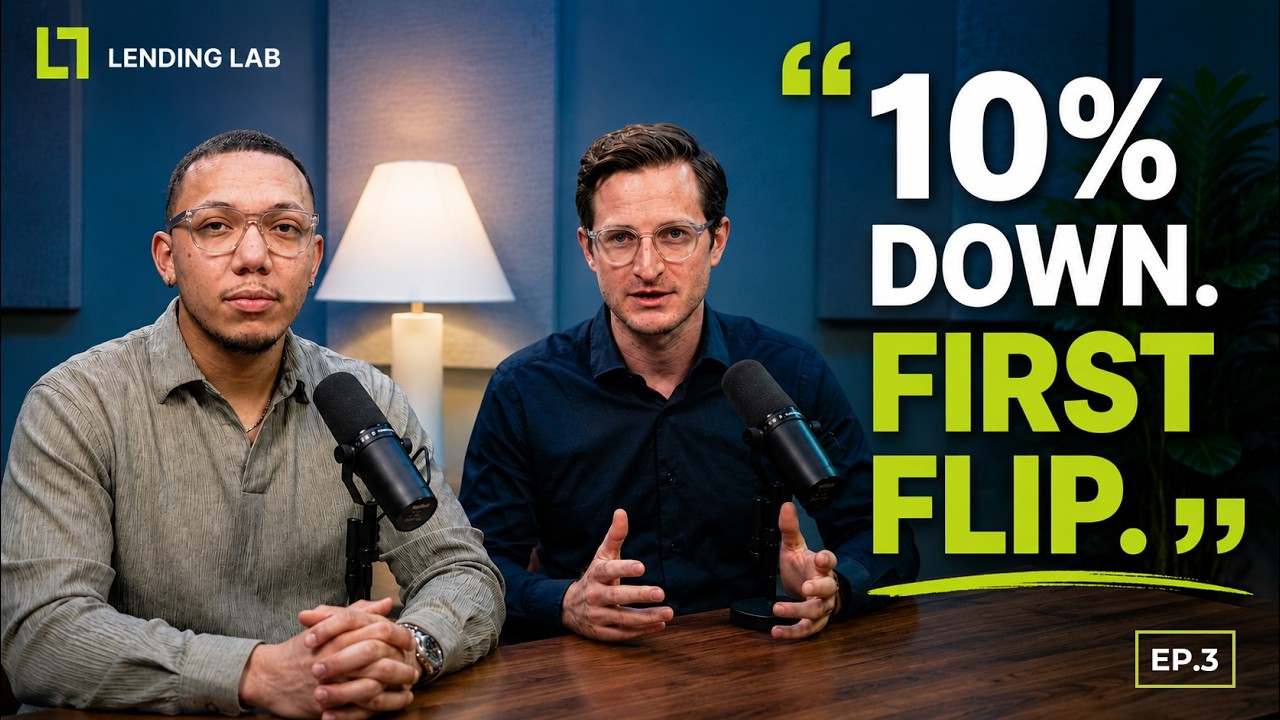
Welcome back. Welcome back, everybody. Thank you for joining. This is “The Lending Lab.” This is “The Lending Lab.” I am Trevor Javier Burns.
This is my colleague, Blake Orman. Over the past couple of months, we’ve worked really hard about building up this webinar podcast into something really special, and we appreciate you guys for joining us, for being a part of this, and for seeing what we’ve built here, and seeing the future of our Faco webinars- Yeah … in the future. If you guys have seen any of the previous episodes, we thank you guys for watching those, and hopefully, you guys can see the growth that we have made as co-hosts on this platform, and you guys can relate it to you guys as a growth as an investor.
We’re trying to make this a world-renowned top five webinar on Apple, Spotify, wherever you get your podcasts. Wherever you are, on YouTube. So we’re going to make this the next big thing when it comes to real estate. But let’s now talk about executing the ideas you have when you are a real estate investor and you want to execute the idea and make it a profitable solution, and how you can build with Faco.
All right. So here, let’s break it down. Break it down. You’re the fix and flipper.
I’m the idea in your head. All right. So I think about flipping a house. You’re going to flip your first house?
I think I can do that. But you just moved to Florida. How far should I go out? How much- I think you should stay within 20 miles of where you live right now.
What’s my price range? I think you should stay with under 500,000 for your first buy. Under 500? Yeah.
I only have about 300K saved up. You have 300K saved up. Mm. Did you call Faco?
No, I haven’t. I haven’t done any research on it. Any research. I don’t know how to find a property either.
So before you find a property, you’ve got to make sure you find a lender. You need a lender? Yeah, you need, well- I need capital … you need, you’re looking for a property for 500 and you have 300.
You’re not going to invest your entire life savings into this deal, primarily because that would be not the most financially bright decision. I’d recommend to put some money into a savings account and take the rest and put that into a fix and flip. So call Faco, and Faco will be your capital partner. Ooh.
And I bring in the rest. So you’re a first-time flipper, right? I am. What’s your FICO score?
I’m around 700. So that’s 700. 770, you said? 700 to 740.
I haven’t checked in a while. It’s been a while since I’ve checked these things. I’m kind of nervous about getting into this business. So let’s talk about- This is something new for me, man …
let’s talk about fix and flippers with zero to three flips completed, and the type of products that we can offer for someone such as yourself who’s looking to get into their first flip. So we’re looking in Florida. Let’s call it somewhere in Broward County, where you’re going to buy a flip, a distressed house for 450,000. This is your first flip.
You want to put down 10%. I do. And you want to see a FICO above 740, and you can qualify for 10% down. Sure.
So we’re looking at 450. We’re looking at 45K down. Now that 300,000 in your bank account is really only going down to 250. Yeah, and I can use some of that for the rehab of the project.
Well, no. We actually financed all the rehab. So you’re going to need 10% down, which is the 45,000, and then you’re going to need, call it, 10 to 20,000 of your rehab budget to get you through the next couple draws. Mm.
We recommend to have all of your budget, but it really depends on your cash management. Okay. I think I can get this done, but I don’t want to hire too much of a team. I don’t want to have all these contractors trying to get in on the project when I know how to swing a hammer.
I know how to screw. You’re going to do everything yourself? I know how to do all this stuff. I know how to put in new lights.
So what’s your budget? I want to think my budget’s around 35 grand. Is that too low? I haven’t seen the property yet.
I don’t know how much I’m going to be able to sell this thing for either. What’s the ARV? My realtor says that once I buy a 500K property, I put 35, I can be able to sell it for 650 at most. Or is that a little too high?
I’m not too sure. I don’t know anything about this market. We need to see the comps in the market to make sure that 650’s supported. How do I do that?
You should call Faco and use the comp tool and talk to your loan originator and see if there is comps that support a 650K exit. All right. So let me call an originator at Faco. Let me find out a little bit more information.
Should I put them in touch with my realtor, too? No. But I’m not in contract yet. So why should I call Faco if I’m not under contract?
They’re going to think I’m a joke. Because you’re going out there and looking at properties, but you’re not going to have enough money to buy it. So you need to make sure you have financing lined up in order to buy that property. So I just need to build that relationship first.
Exactly. We see this all the time. Get pre-approved with your lender and make sure that you have the capital lined up, enough for your down payment, enough for your financing budget, enough for your draws, and the lender brings the rest. Mm.
So that’s the beauty of working with Faco. From the top, that is how these things really start. Mm-hmm. Do you want to be your own boss?
Do you want to work for yourself? Do you want to quit that nine to five? These are the questions you need to ask yourself. Blake is my brain asking my heart these questions, in a sense.
That’s exactly how it works. That’s exactly how the process works. These are discussions that Trevor and I have with investors every single day. So let’s start from the top.
Let’s talk about our fix and flip product. So we’re at 10% down. We’re at 10% down. For experienced investors and first-time investors as well.
So that means they need to have good credit scores or a large amount of experience. A FICO above 740 will qualify you for 10% down. That is what we like to qualify strong credit. Your credit is your credibility when you’re talking about financing.
Your credit is your most important piece that you have to your name, realistically. Mm-hmm. That’s the closest thing that you have to your historyIt allows the banks to know, oh, can I give this guy this much amount of money? It allows your credit cards to be like, do you- Can you qualify for this credit card?
Yeah. Are you able to manage $20,000 in credit- Yeah … and pay me back on time and in a sufficient amount of time? Oh, yeah.
So it’s just about playing that money management. And if you don’t have much financial literacy, it’s perfectly fine. FACCO is here to help. FACCO literally stands for Finance of America Commercial.
Sure. And what are some of the biggest challenges that you run into when speaking to new investors and them looking for financing? As a loan originator, what are some of the challenges that are out there that we can solve as a lender? So some of the challenges that we can solve as a lender is kind of the housing crisis that we’re going through.
There are a shortage of houses in the US. There needs to be more renovated houses. A lot of these people that are trying to get into fix and flips or rehabs watch HGTV. It’s not a get rich quick scheme at all.
They explain the process of building a house or renovating a house within a 30-minute episode. But it really takes sometimes even six months. It takes six months, even sometimes 12. Right.
Because sometimes an investor could be in over their head. They have a great idea in their mind. They say, “I want to do this 500K ground-up construction.” Everybody has an idea. Mm-hmm.
It’s all about the execution. It’s all about- So you’re solving this housing crisis challenge through investors. The investors are trying to solve, how can I beat my nine to five and make more money by working for myself? Us, as a lender, is trying to solve this housing crisis where there aren’t enough homes, there aren’t enough renovated homes, there aren’t enough places for people to live all around the country, making housing more affordable in the US.
That is one of our biggest goals that we’re trying to tackle head-on as a lender. Mm-hmm. Creating homes and building real estate for most of Americans that can afford this home. Right.
The borrower’s looking to leave their nine to five, become their own boss, and we’re trying to solve that housing crisis. Yeah, like we said before, it’s about beating that nine to five. How can I be my own boss? Not just that, but allowing to see different avenues to make a living.
Right. So it’s not just one way, we’re working a job our whole lives and just working for a paycheck. There’s different avenues to it. You can have fun with it.
And when we see our investors, they’ve worked for years and years of years at a nine to five, but when they come to investing, they have a lot more fun. They have a lot more freedom in their life. And when you think of FACCO, what are the first three words that come to mind? Three words?
Yeah. I think of freedom. Freedom. Financing.
And relationship building. Relationship building. That’s beautiful. Now harp in on that relationship building.
Tell me more about what the relationship process really looks like and what problems you’re solving with that long-term investment of a real estate relationship. So when we’re talking about a real estate relationship, we’re talking about something that’s potentially lifetime. So when I first meet somebody, I don’t want to just be a one conversation, hi, bye, let’s do a transaction, and then you’ll never hear from me again. Real estate has been slowly becoming my life.
This has been my passion for the last three to four years. So if I’m passionate about something, and I have somebody who’s also equally as passionate, let’s say a realtor, say one of my best clients. I met her through a text one day, said, “Hey, wanted to see if you’re in the market for any financing.” That one text then led into a phone call conversation where we just hit it off. Now she can call me at 8:00 p.m.
at night, 10:00 p.m. at night, and I will pick up the phone and vice versa, and now we’re going to meet each other, and hopefully, she can be a part of my future life goals for financing with her. She can help me find properties in the Northeast, and there’s a mutual exchange. Everything, when we’re talking about marketing, we’re talking about financing, there has to be an equal exchange of value.
And how many deals have you done together with this investor? With just this one investor, it’s about 10 investments in the last year or two. And where does this investor typically do their deals? This is in Massachusetts.
Massachusetts. But like I said, it’s about that equal exchange of value. Tell me about freedom a little bit. So freedom, the freedom to becoming a real estate investor is you have the flexibility of your own schedule.
Yeah. You’re not working on somebody else’s clock. Yeah, people are going to be calling you all the time, asking you, contractors calling you, tenants calling you, but you can pick up whenever you want. You are the boss.
They want to talk to you. Your clients and your investors in your book feel that sort of freedom of being their own boss- Mm-hmm … and quitting that nine to five, becoming their own boss, but having that entrepreneurial mindset. It allows- Tell me a little bit about how our products and our solutions at FACCO can solve problems within their business that they have already.
Let’s talk about someone who already was a real estate investor, came to us, and we were able to work with them even though they’re already working with other banks before they met us. So let’s talk about somebody we took on. One of my current clients, he’s known for calling all the banks, looking for the best deal, looking for the best offer. But all in all- He’s shopping around …
that’s what we like to call a shopper. Yeah. All in all, he wants the best deal. He wants to pick his appraisers, too?
No, he doesn’t want to pick his appraisers. He understands that appraisals are what they are. They’re supposed to be unbiased, third party, with no sort of influence forced upon them. But he wants the cheapest loan possible.
He wants to be- Lowest rates- In and out … lowest terms. So this guy’s aDifficult. But he’s over here using other people’s quotes to shop quotes to get your rates lower.
He’s going from Best Buy into Target and taking that product and trying to see which one he’s going to get the cheapest. Exactly. But then all in all- Those ones are always very difficult to work with. They’re very difficult to work with, but when you can get them done, you can gain their trust, you almost have their business for life, in a sense.
So let’s take- You do, but sometimes you need to stay firm to not undercut Best Buy’s pricing just to become Target’s pricing. Exactly. Because all in all, like we said in the beginning, there’s a value exchange. That’s true.
So you don’t want to undercut everything that you have into the deal. We call that a race to the bottom. Mm-hmm. That’s not the best strategy in this market.
Even when you’re in the real estate investor’s shoes and your house has been on the market for a long time, I always see that when people lower it, they do end up getting a number that they weren’t as happy with and staying firm on the number they had before. So that’s also similar to sitting on their side of this puzzle, race to the bottom. Same with our race to the bottom. Yeah, when you race to the bottom- And we don’t want to race to the bottom …
we don’t want to race to the bottom as a loan originator. No. Because if you’re working for the lowest commission possible, you’re not really that motivated to get the deal done as fast, keep building that relationship, unless you’re giving that pricing organically. So this guy, where is he investing?
Mainly in the Illinois State. How were you able to take his business from the competitor and bring it over to Fatco? I told him, “Hey, we’ll get it done in two weeks. I’ll get you the exact pricing we want.
The yelling, the screaming, the going back and forth, we don’t want any of that.” You sold him on speed. We sold him on speed. And you sold him on the draws. And we sold him on the draws.
How many draws does he usually take? He takes draws every three months. Oh, so he takes out not that many. Not that many.
He does three draws a loan. Three draws per loan. How many loans have you done with this person? At least 10 now.
Okay. All right. That’s pretty good. He just submitted a new one recently.
He said, “You have my business for life now. I know you have the execution. You will get me there on time, and then you will always put up with all of my challenges, even when the ARV comes back a little lower.” Nice. And we’re also very similar in age.
We’re both young investors into the space. Yeah. So there’s kind of a mutual respect for both young men in their early 20s hustling to make a name for themselves in the real estate world. Great.
So there’s kind of a mutual respect there. So he knows I’ll get the deal done. Don’t overdo it with trying to go around shopping, doing all that. Does he still shop now?
So he was shopping when you did your first deal together. Mm-hmm. The next nine were all directly to you and no shopping involved. No shopping involved.
Wow. So how’d you win this guy over? He was a DJ. I went to one of his parties.
I made an- This is when the lending lab gets personal. Exactly. I made a- It’s all about business … I made an effort to go meet him in person.
I went to go do what he likes to do on the side, what he likes to do for fun, and I made an effort to go shake his hand in person, understand that, hey, I’m a real person. I’m across. And how’d you enjoy that? It was a cool party.
Good concert? It was a cool party. I feel good. Okay, cool.
Good. But going forward, I’m not really a party guy. I don’t really like to party too much anymore. You’re not at college.
You’re not a frat boy anymore. I’m not in college. I’m not. You’re a vice president now.
You got to play the part. Exactly. So that’s what we’re talking about when we’re talking about the freedom, the relationship building, and then what was the last one that I said? Freedom, relationship building, and financing.
And financing. So- That’s the beauty of our relationship, but I think one piece that I would love to add to that entire puzzle is being that all-encompassing lender to offer other services instead of just offering just the financing. Yeah. That is our primary services here, being fix and flip, ground up, and DSCR financing, but we also offer closings, internal closings.
We also offer insurance, and we also offer appraisals through Tamrisk. Allowing all of that. So when we’re doing everything internal, that kind of makes you that one-stop shop that we’ve mentioned. So we want to make the transaction as easy as possible, as quick as possible, and as enjoyable as possible for our clients.
So- I agree … so explain a little bit more on how being internal on all of our processes makes it a lot more enjoyable for your clients. So I find that when all the services are in-house, it makes it a lot more of a streamlined process that you are starting to connect with other groups in the company. Mm-hmm.
And all the information is shared between the borrower and the property so that the insurance can get their quote together, the internal team can get their closing and title work done together, and that the appraiser can get all the property information to get the report back in time. Now, we can also do real val instead. Whether it’s going to be an internal appraisal or external appraisal, we have all the information to get it done and close this loan within seven to 10 days. That’s a seven to 10 days.
We’re seeing a big speed in the run-up in this industry from 2020. How have you- When I first started working in the private lending space, I was seeing loans close a little bit longer. Mm-hmm. Appraisals were taking longer.
We were seeing turn times about three weeks. Three weeks. We’ve shaved that down to about one and a half to two weeks now- There we go … with the real val loan.
Nice. So how has, overall, the whole space of lending changed in the last five years? Talking about half a century now. So I’ve started working for Fatco as an intern around three to four years ago.
Mm-hmm. When did you start working for Fatco? How have we evolved from being a lender that can close in three weeks to a lender that can close in two weeks, but how else have we evolved from that? So I think through technology, we’ve shown that theWe’ve been able to execute our draws quicker than we’ve had it in the past.
Previously, we were sending out an inspector to the property, and that inspector would have to go and take pictures of every room and then put that into a report, and then submit that report to us, which gets reviewed and ultimately funded a draw. That usually take five to seven days. It used to take five to seven days. Now, with our technology, through our mobile app, the borrower’s going to the property, they’re snapping pictures directly from their smartphone, and they’re putting those pictures, which gets generated directly into a report.
Much less work than previously. The report is getting built, and the report is getting reviewed by the draws team, through our team of seasoned architects. Mm-hmm. And they are putting together a funded draw, typically in 48 hours or less.
So Monday draw comes in, it’s usually funded by Tuesday night. And I think that’s one of the biggest and most exciting features I’ve seen ever since I started working at Fatco. That’s one of the biggest tech enhancements that I’ve seen. And then you said five to seven days for the draw to be completed.
Used to be. Now it’s two days. I’ve even seen draws when the inspector goes out, it takes two weeks. Sometimes it takes a long time.
They can’t get access, they can’t get a hold of the borrower. So you have a borrower ripping their hair out, invested $30,000 for them to be reimbursed, and they can’t get their money reimbursed back because the inspector’s not completing the report. Right. So they’re completely waiting on a third-party company to take pictures of the property, inspect what’s been completed, review it for them, and then tell us, “Hey, give them 15,000,” or, “Give them their full draw back.” I want to say up until one, two, two and a half years ago, this didn’t really exist across the industry.
This is something that’s newer. The beauty of this technology is it can geotag where the pictures are taken, so we can confirm that it was taken at the loan that we’re referring to. So 123 Main Street, for example. We can use the app technology to confirm that we’re at 123 Main Street, and we’ll also confirm the time.
Mm-hmm. So if the property closed December 1st, it’s now January 1st, it’s been 30 days, we know that this time has passed. Yep. And we can confirm that it’s been 30 days, so we can look at the pictures from the appraisal, we look at pictures from January 1st.
And we can say, “Look at all this work that’s been done. All the tile, all the floor has been ripped out. We now have new tile. We now have new flooring.
We now have new countertops. All this house has been fully renovated in 30 days.” And we can see that the time has passed, and we see that work has been done. We can verify it, and we can get that wire out that same day. Now, us as the lender now can trust the investor to go do another project- Right …
with the same speed, because he just did it. Exactly. So. That helps the investor also trust us to know that they have the capital behind them.
Yeah. And they can keep doing draws and get their money quick enough. So that’s very helpful for them too. And that helps the value exchange, the relationship building that we’re here at Fatco trying to do for all of our clients, all of our borrowers.
And so we have the speed of our closings, we’ve enhanced our technology, our draws. We now have a portal and a app. So you log onto the portal. Once you have a loan submitted, you submit all the documents that we request.
What do we usually request when we’re talking about a fix and flip? We’re fairly simple. We’re more of an asset-based lender than we’re looking at the actual- It’s a low-doc loan. Hmm.
People ask for no-doc, people ask for high-doc. I would say that we’re a low-doc loan, so we don’t need bank statements or tax returns. We’re going to need a purchase contract, scope of work, and an appraisal on the property side. On the borrower side, we’re going to want to see what their net worth is.
Mm-hmm. We’re going to want to see the track record and a credit score. It’s a soft pull, it’s good for six months. That seems very, very low.
It seems reasonable, right? And then once these clients- If you’re a first-timer, we don’t need a track record. Sorry to interrupt. Yeah, no, it’s all good.
But when you’re a repeat client, when you’ve enjoyed your first experience with Fatco, and you come back for a second one, you cut the documentation down to half at that point. Because all the information’s saved on file, your credit score’s saved on file. Mm-hmm. You nailed it.
Everything’s cut into half. We get an appraisal, purchase contract, scope of work. Mm-hmm. And assuming we’re using the same entity that we used on the last loan, this loan’s going to get funded, and it’s going to get approved a lot faster because we already have everything else verified from your past transaction.
We’re building these relationships. We want it to be easier, faster. Right. You upload three things to the portal for your loan.
That’s your purchase contract, that’s your scope of work, and then you pay for an appraisal. Right. Those are the three things you pay for once you become a repeat client with Fatco. So we’ve enhanced our process, we’ve enhanced our technology and our speed.
And then on top of all that, we’ve also, in the last five years, we’ve enhanced our leverages. We have. So first time investors, when I first started, you used to do 30% down. It was 30% down for a first timer.
Mm-hmm. And a minimum FICO score of 660. 660. Now- That still stays the same, minimum FICO, 660 …
now minimum FICO is 660 to 680. But now it’s now jumped from 30% down to 20% down for a first-time investor. And then take that even up a notch, if they have a 740 credit score. They’re getting 10% down.
They get 10% down. And I think that’s a beautiful product. It’s been actually helping a lot of people get into that project that they wouldn’t have been able to afford in the past. Mm-hmm.
Because they’re putting down less money for the down payment and having that more money in cash reserves in their account currently to use for the construction. Mm-hmm. And use for draws to get reimbursed by Fatco. Yeah.
And these are the opportunities that investors that, like we started this episode, who have that idea, these are the building blocks or the tools that Fatco can provide for these borrowers with new ideas to become their own boss. Yeah. To quit their nine to five, to have the freedom, the financial freedom to go to their kids’ soccer games, go to their- Be the coach. Be the baseball coach.
Mm-hmm. Yeah. Be the baseball coach. Be the basketball coach.
Have fun with it. Give back to the community. Build the housing in the neighborhood. And be the neighborhood.
And be the neighborhood. It helps you feel good in your heart not only as you’re helping the community get better housing. We’re technically helping these people build better housing in their areas, in their zip codes, in the areas that they flip, and also being able to be a better, a more present parent to their family. Be around for that game, for that dinner.
Mm-hmm. Be around for your cousins, be around for special family memories. Because you are your own boss, you have the ability to do more of the personal things you wanted to do in the past. Yeah, and then even on our last episode, we spoke about Georgia.
Or on one of our previous episodes, you spoke about an investor who completely does light and cosmetic rehabs. Yeah. He hasn’t even done crazy rehab budgets or ground-up constructions. He can.
He can qualify for them, but he has his avenue, he has his lane. And our investors find their lane that they stay in, and they don’t really want to deviate too much. That’s it. What works for them works for them.
Agreed. It’s a rinse-and-repeat process, and you don’t really want to deviate from what works. Right. Once you start changing up what works, that’s when things can start getting shaky a little bit.
I like to say, “If it ain’t broke, don’t fix it.” Mm-hmm. So follow the same steps and the same process that you followed on your last loan in order to get success on your next loan. Exactly. If that first project was successful, repeat it.
If the first project was not successful, figure out what went wrong and fix it on the next loan. And there’s always a risk to take when you’re investing a large sum of capital. It’s never going to be perfect. There’s no recipe that’s the same for every single flip because some house might have mold and some house might have a water leak.
Mm-hmm. You need to prepare that contingency and that 10% rainy day fund in your scope of work in case there is something that comes up that wasn’t expected. Swing and miss. It’s all about getting more reps in.
Mm-hmm. You’re going to swing and miss, and then once you hit those home runs, you’re going to be hitting them all day. That’s it. So that’s what we’re trying to do at Finance of America Commercial.
We’re trying to help you guys learn the ins and outs of real estate, understand what is financing, how can you use it to better your lifestyle, better your business model. Yep. And overall, just be your one-stop shop, not the one-time stop shop. Right.
Be your own boss. Be your own boss. If you guys have any questions, Blake, if you want to have any closing remarks for this one, please tell the crowd right now. I would just say my closing remarks is that the idea is nothing without the execution.
So go out there and find that first flip so you can execute it. Put together the team, put together your own capital. Put together a spreadsheet of how much financing you need, how much capital you really need to get that first deal done. Go out and find your first deal.
Give us a call. We’ll run the numbers, see how much financing you can qualify for, and we’ll get it funded in two weeks or less. It’s going to be a 12 to 18-month bridge loan in order to fix and flip the property, and we’d love to figure out a way to do business together in 2026. Figure out what works for you until you become a seasoned investor, basically become your own boss.
That’s it. And- Drop that nine to five … you can now become an entrepreneur using the art of financing. So if you guys have any questions at all, learning any tips, any more tricks, watch any of our previous episodes.
We have a lot coming out more. We have some goals coming up for 2026, 2027, is to get more guests on the pods and the episodes following. Yep. So- We’re going to have somebody dialing into our next call as well.
We’re going to have some live content coming up at future conferences coming up over the next couple of months. So stay tuned for all that. Stay tuned to all of it. So Finance of America Commercial is facolending.com.
This is my colleague, Blake Orman. I’m Trevor Javier Burns. Follow us on Instagram. We’ll see you guys next time.
Thank you, guys. See you next time.